Monastic visitation and dissolution
Wolf HallMonastic visitation and dissolution is the evolving royal programme to inspect, reform, and potentially close religious houses, and to place their wealth under the authority of the crown. Its decisive change is from a political claim about who may govern the church to a practical system of visitation, information-gathering, and enforcement. Thomas Cromwell’s appointment as Vicegerent in Spirituals gives him the power to visit, inspect, and reform monasteries, including closing them if necessary; the process brings the resources and jurisdiction of religious institutions into the machinery of royal government.
From Political Claim to Administrative Power
The policy develops within a wider struggle over the authority of Parliament, the crown, and Rome. In 1532, Parliament considers measures that would cut revenues paid to Rome and make Henry VIII’s supremacy in the church more than a formula. The Commons drafts a petition against church courts, challenging both their arbitrary proceedings and their claimed jurisdiction. Thomas Cromwell, Rafe Sadler, and Thomas Wolsey’s former adviser Thomas Wriothesley work through amendments late into the night, while Stephen Gardiner leads episcopal resistance. The confrontation shows that the extension of royal authority is not merely a dispute about wealth: it concerns which institution may make and enforce rules in England.
The novel gives this institutional shift an intellectual argument as well as a political one. Thomas Cromwell presents Henry VIII with propositions from Marsiglio of Padua, including the claim that Christ did not grant the clergy authority to make laws or levy taxes, and that priests remain subjects of the secular ruler. In this account, political authority derives through a legislative body acting for the people, while control of church wealth belongs to secular government. Henry moves quickly from the argument to its material implication, asking how church wealth might be freed and suggesting that shrines could be broken. Thomas Cromwell had intended to lead him through a more intricate legal process; the king’s readiness to imagine physical dispossession exposes how quickly an argument over jurisdiction can become an argument over property.
Visitation as Information and Leverage
The appointment of Thomas Cromwell as Vicegerent in Spirituals gives the programme an executive instrument. Rumours that religious houses will be suppressed have circulated for years, but he now has formal authority to visit, inspect, reform, and close them. His knowledge comes from more than a royal title: years of work under Thomas Wolsey have familiarized him with abbey affairs, while a continuing flow of letters brings reports of abuses and scandals, accusations of disloyal superiors, and requests for preferment from monks seeking to put themselves in his debt. Visitation therefore appears both as inquiry into religious institutions and as a channel through which their members seek influence within the new order.
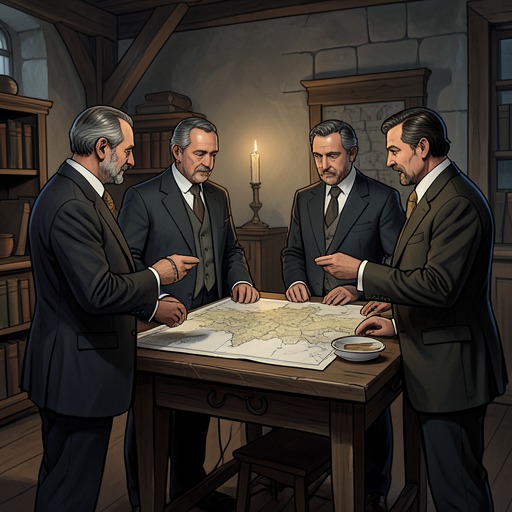
The scrutiny is also fiscal. Thomas Cromwell’s commissioners are sent out to establish the value of church property in the survey called Valor ecclesiasticus. He promises to complete it in six months, despite the unprecedented scale of the undertaking. The book describes this work as a response to the accumulated complexity of ownership and law: the crown needs to know what the church possesses if it is to take control of those assets. A thousand pens scratch at Westminster, but new men, structures, and ways of thinking are required to turn information into governing capacity. The survey makes religious wealth legible to the state, linking administrative measurement to the possibility of redistribution.
That process has an earlier political prehistory. After Thomas Wolsey’s fall, the Duke of Norfolk believes that the cardinal has hidden treasure and suspects Thomas Cromwell knows where it is. Cromwell’s place in the emerging regime is consequently entangled with the seizure and redistribution of Wolsey’s lands: he tells Anne Boleyn that he expects to recover what he has spent on the cardinal and describes his payment as a conveyancer’s fee. The episode establishes a pattern in which political access, property, and service overlap. The later scrutiny of monasteries extends that pattern from the fortunes of one fallen minister to the holdings of religious communities across the realm.
Parliamentary Tactics and the Resistance of Institutions
The parliamentary struggle over church revenues shows how the new order identifies opposition as well as advancing legislation. When Thomas Cromwell introduces a bill suspending the payment of annates to Rome, he calls for a division of the House, an unusual procedure that forces members to stand on one side for the bill and the other against it. Henry VIII watches and learns who supports him. The tactic does not work in the Lords, where the king must appear and argue his own case three times. Old aristocratic families, including the Exeter clan, support Pope Clement VII and Katherine of Aragon and are willing to say so. Thomas Cromwell is not simply gathering votes: he is identifying opponents and, where possible, splitting them.
This conflict returns in the debates over the clergy’s submission to royal authority. Katherine tells Thomas Cromwell that the clergy have been made liable for more than one hundred thousand pounds under the pretext of a benevolence; she calls the payment extortion. She objects to attacks on the bishops even while acknowledging that she had been an enemy of Thomas Wolsey, and distinguishes hostility to an individual churchman from loyalty to the church. Her resistance makes the limits of the new policy visible: the crown may describe its measures as law and reform, while its opponents experience them as financial coercion and an assault on ecclesiastical independence.
By 1534, Thomas Cromwell’s account of secular jurisdiction meets a sharper theological objection in Thomas More’s reported argument. Richard Riche says that Thomas More distinguished Parliament’s power over temporal jurisdiction from its inability to determine spiritual jurisdiction, which More regarded as beyond the realm. Thomas Cromwell recognizes the political consequence: if Parliament cannot name the king head of the church, it may also be denying the king’s title. Yet More has not plainly stated this as a denial, and Thomas Cromwell weighs the difficulty of proving that his words were malicious rather than part of an argument. The exchange clarifies what is at stake in the wider campaign against church jurisdiction: the claim that Parliament can govern the church is itself disputed as an unlawful reach beyond the realm.
Pace, Reform, and Coercion
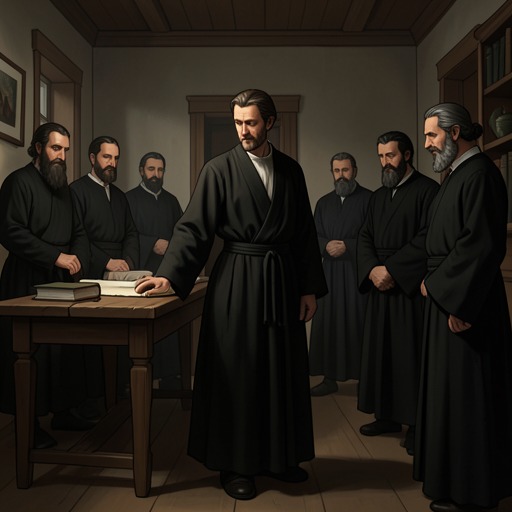
The book distinguishes the authority to inspect and reform from immediate, indiscriminate suppression. During an illness, Thomas Cromwell asks that Prior George keep the friars away from the streets when the king visits, lest Henry reform them too soon. Cromwell wants the process to move slowly enough for people to see its justice and rejects the idea of spilling religious communities onto the streets. The neighbouring friars are, in his view, a disgrace to their order, but they are also his neighbours: they have yielded their refectory, and their precinct remains part of the life around his house. His position joins reforming judgement to a concern about the disorder that abrupt enforcement could produce.
That measured approach does not remove pressure on communities that refuse the king’s demands. Thomas Cromwell has visited the London Charterhouse and the resistant community at Syon, using gentle persuasion, blunt speech, threats, and the arguments of reform-minded clerics. He has also interviewed disaffected members and set them to work against their brethren. None of these methods changes the response of the monks who will not submit: they ask to be left to their sanctified deaths. The sequence reveals visitation not as neutral inspection but as an escalating encounter in which information, persuasion, division, and threat all serve the government’s purpose.
The consequences are shown in the treatment of the London Charterhouse monks. The law demands the full penalty for traitors, and the narration describes a public execution marked by hanging, disembowelling, and the visible suffering of those awaiting death. The king considers witnessing the spectacle in disguise but fears that the crowd might demonstrate for Katherine; Henry Fitzroy is sent in his place. Thomas Cromwell later rejects the Duke of Norfolk’s report that one monk spoke after his heart had been removed, claiming experience as the basis for his denial. The story therefore sets the administrative language of reform beside the bodily violence of enforcement. Monastic visitation and dissolution is not depicted as a completed, uniform event, but as a developing programme whose claims about law and reform can culminate in punishment for religious resistance.